Simultaneous Inference of Basal Friction and Ice Rheology
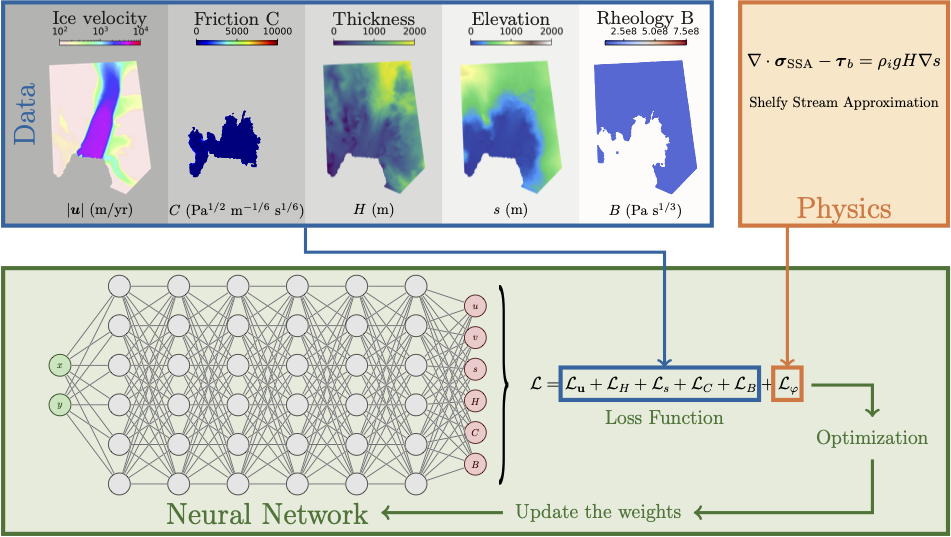
This example showcases PINNICLE’s ability to solve multi-parameter inverse problems, where both basal friction and ice rheology are simultaneously inferred from observational data, using the Shelfy-Stream Approximation (SSA) model. The case study uses real geometry from Pine Island Glacier (PIG), Antarctica.
Problem Description
The goal is to infer two spatially varying parameters:
Basal friction coefficient (\(C\)) beneath grounded ice
Rheology pre-factor (\(B\)) within the floating ice shelf
The problem is solved using the SSA with Glen’s flow law, expressed as:
with:
\(\sigma_{\text{SSA}}\): stress tensor
\(\tau_b = C^2 |\mathbf{u}|^m\): basal friction (Weertman law)
The stress tensor is defined as
where the viscosity \(\mu\) is
where \(B\) is a spatially varying pre-factor.
Configuration
The domain is larger than the examples of Helheim Glacier and uses more data and collocation points to ensure adequate resolution.
We use "SSA_VB" equation to account for spatial dependent pre-factor \(B\).
hp["epochs"] = 1000000
hp["num_layers"] = 6
hp["num_neurons"] = 40
hp["fft"] = True
hp["sigma"] = 10
hp["num_fourier_feature"] = 30
hp["shapefile"] = "PIG.exp"
hp["num_collocation_points"] = 18000
hp["equations"] = {"SSA_VB": {}}
We also need to set, as boundary conditions, for the pre-factor \(B\) to constant \(1.41 \times 10^8 \ \text{Pa s}^{1/3}\) on the grounded ice and friction coefficient \(C=0\) for the floating ice:
hp["data"] = {
    "ISSM": {
        "data_path": "PIG.mat",
        "data_size": {"u": 8000, "v": 8000, "s": 8000, "H": 8000}
    },
    "BC": {
        "data_path": "BC.mat",
        "data_size": {"C": 4000, "B": 4000},
        "source": "mat"
    }
}
Loss Function
The total loss includes:
where:
\(L_u, L_H, L_s\): data misfit terms for velocity, thickness, surface elevation
\(L_C, L_B\): boundary condition for basal friction and rheology
\(L_\phi\): PDE residual from SSA equations
Results
After 1,000,000 epochs, PINNICLE infers the following:
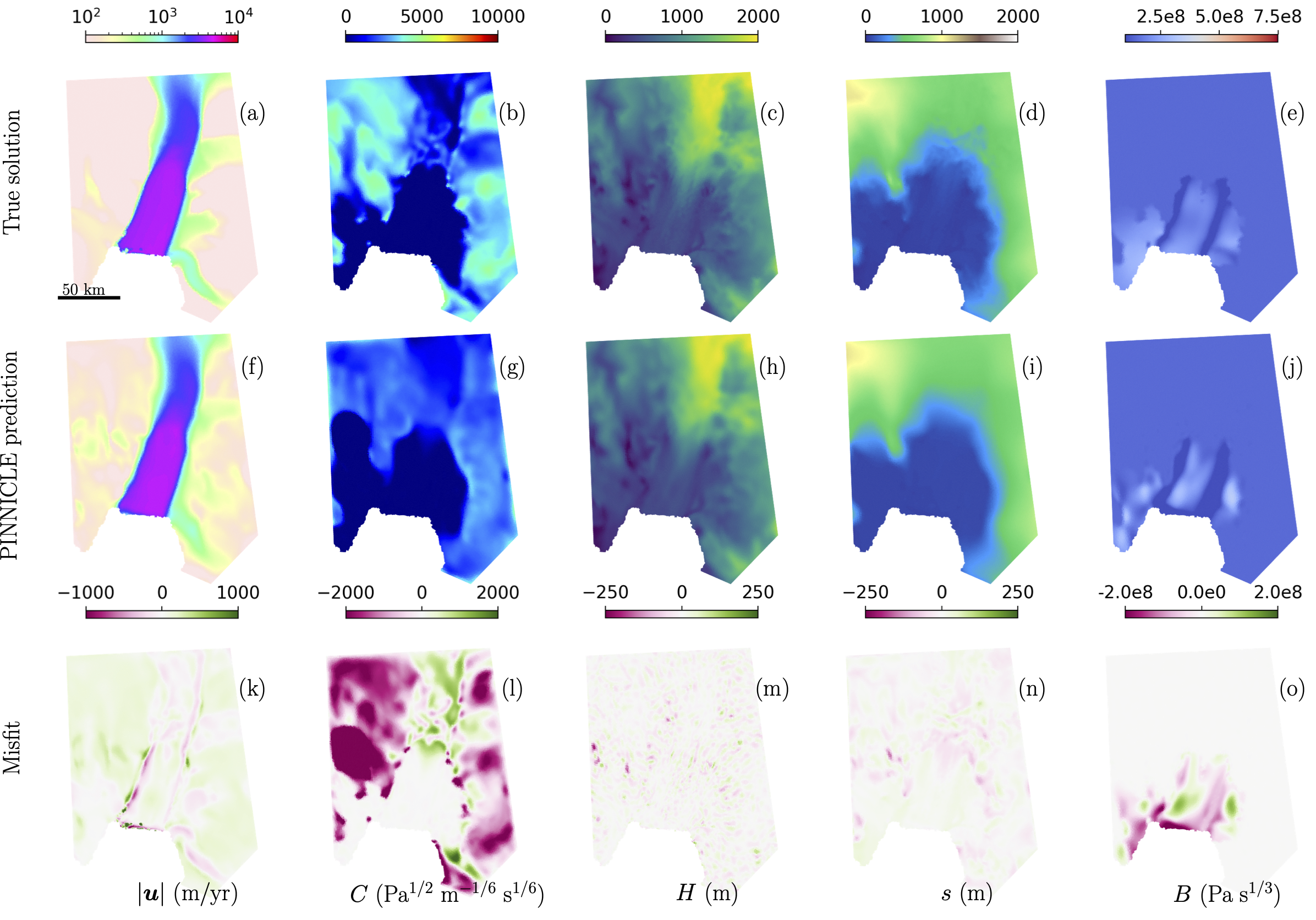
First row: reference “true solution” (from ISSM)
Second row: PINNICLE predictions
Third row: misfit between prediction and reference
References
Cheng et al. (2024). “Forward and Inverse Modeling of Ice Sheet Flow Using Physics-Informed Neural Networks”
Complete code
import pinnicle

# hyperparameters
hp = {}
hp["epochs"] = 800000

# NN
hp["num_neurons"] = 40
hp["num_layers"]  = 6
hp["fft"] = True
hp['sigma'] = [1, 10]
hp['num_fourier_feature'] = 20

# domain
hp["shapefile"] = "PIG.exp"
hp["num_collocation_points"] = 4500
hp["period"] = 100

# physics
hp["equations"] = {"SSA_VB": {}}

# data
issm = {}
issm["data_size"] = {"u":4000, "v":4000, "s":4000, "H":4000}
issm["data_path"] = "PIG.mat"
B = {"data_size":{"B":4000}, "data_path":"B.mat", "source":"mat"}
C = {"data_size":{"C":4000}, "data_path":"C.mat", "source":"mat"}

hp["data"] = {"ISSM":issm, "B":B, "C":C}

# create experiment
experiment = pinnicle.PINN(hp)
experiment.compile()

# Train
experiment.train()