Neural Network Architecture
PINNICLE supports two types of neural network architectures:
Fully Connected Neural Network (FNN) Default architecture used in most problems. All output variables are predicted jointly by a single neural network.
Parallel Fully Connected Neural Networks (PFNN) Each dependent variable is predicted by its own sub-network. Useful when the relationships among variables are too complex to be learned jointly.
FNN (Default)
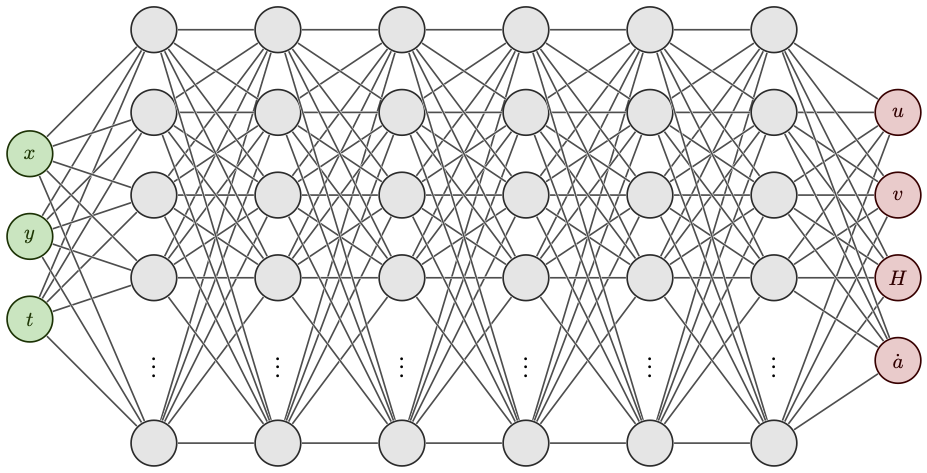
One input layer (e.g., \(x, y, t\))
Multiple hidden layers with activation functions
One output layer (e.g., \(u, v, H, C\))
PFNN
One network per output variable
Shared inputs across all sub-networks
Useful for ill-conditioned or weakly coupled systems
Configuration
The neural network is configured using the following parameters in the hp dictionary:
hp["num_layers"] = 6             # Number of hidden layers
hp["num_neurons"] = 32           # Number of neurons per layer
hp["activation"] = "tanh"        # Activation function (default is tanh)
hp["architecture"] = "FNN"
You can also set each layers with different number of neurons:
hp["num_layers"] = 6
hp["num_neurons"] = [128, 128, 64, 32, 32, 32, 16]
For PFNN, "num_layers" is the total number of layers, including the input and output layer, therefore, to have different number of neurons, you only need to define for the hidden layers
hp["architecture"] = "PFNN"
hp["num_layers"] = 6
hp["num_neurons"] = [64, 32, 32, 16]   # only 6-2=4 hidden layers each
Activation Functions
The default activation is the hyperbolic tangent ("tanh"), which works well in many physical applications. You can change it to:
"ReLU""sin""Sigmoid""Swish"or custom activations from TensorFlow, PyTorch, or JAX
Input/Output Mapping
Inputs: spatial (\(x, y\)) and temporal (\(t\)) coordinates ( if
hp["time_dependent"] = True)Outputs: dependent PDE variables (e.g., \(u, v, H, s, C, B\))
PINNICLE automatically constructs the mapping between inputs and outputs based on the specified physics model and user data.
Normalization
By default:
Inputs are min–max normalized
Outputs are de-normalized to original units based on the data and typical values. The typical values of the lower and upper bounds of the variables are pre-defined in
pinnicle.physics.constants
You do not need to manually scale physical quantities; PINNICLE handles this automatically.
Parallelization and Backends
PINNICLE is built on DeepXDE: https://github.com/lululxvi/deepxde, which supports the following ML frameworks:
TensorFlow
PyTorch
JAX
You can choose a backend following the instruction in installation.